

Are you looking for government jobs after graduation and wondering which career path is right for you? Graduates can explore opportunities in SSC, banking, railways, defence, teaching, civil services, finance, technology, engineering, and other government departments. These opportunities are available to candidates from Arts, Commerce, Science, Engineering, Computer Science, and other backgrounds, depending on the eligibility requirements of each post.
Choosing the right exam and career option can be confusing because different positions have different eligibility criteria, selection processes, and job responsibilities. With the right exam selection and consistent preparation, government jobs after graduation can offer structured career growth and long-term career opportunities. This guide covers popular government jobs, government exams after graduation, eligibility criteria, career benefits, preparation tips, and common mistakes to avoid.
Benefits of Choosing Government Jobs After Graduation
There are several reasons graduates consider government jobs after graduation as a career option. Government organizations recruit candidates for administrative, technical, financial, teaching, banking, railway, defence, and other positions.
Some key benefits include:
- Career stability: Government employment generally offers structured service conditions and long-term career opportunities.
- Competitive salary: Salary and allowances depend on the post, department, pay level, and applicable rules.
- Career growth: Many government positions provide opportunities for promotion and professional development.
- Employee benefits: Eligible employees may receive leave, allowances, retirement-related benefits, and other facilities.
- Different career options: Graduates can choose from administrative, technical, banking, teaching, railway, defence, and specialist roles.
- Opportunities across India: Central government jobs and state-level positions provide opportunities in different regions.
Government careers can also provide a sense of responsibility and an opportunity to contribute to public services. However, every position has different duties, working conditions, and selection requirements.
Best Government Jobs After Graduation
The best government jobs after graduation depend on your educational background, interests, skills, eligibility, and long-term career goals. Instead of choosing a job only because it is popular, consider whether the role matches your strengths and expectations.
Some popular career areas include:
- SSC Government Jobs: SSC conducts recruitment for various graduate-level positions in central government departments and offices. Depending on the post, candidates may work in administration, taxation, auditing, accounts, and other functions.
- Banking Jobs: Graduates can apply for eligible banking recruitment examinations for positions such as Probationary Officer. These careers can suit candidates interested in banking operations, finance, customer services, and administration.
- Railway Jobs: Indian Railways offers different opportunities through its recruitment processes. Graduate-level positions can cover areas such as commercial operations, traffic, administration, and other departments, depending on the notification.
- Civil Services: Graduates can pursue civil services through examinations such as the UPSC Civil Services Examination. These careers involve significant administrative responsibilities and require dedicated preparation.
- Teaching Jobs: Candidates interested in education can explore government teaching jobs. Depending on the position, additional qualifications such as teaching credentials or eligibility tests may be required.
- Defence Jobs: Graduates can explore various defence recruitment opportunities based on educational qualifications, age, physical standards, and other prescribed requirements.
- Engineering Jobs: Engineering graduates can explore government engineering jobs through different departments, public-sector organizations, and recruitment examinations.
Government Exams You Can Apply for After Graduation
There are several government exams after graduation that candidates can consider. The right exam depends on your educational qualification, interests, preferred career path, and eligibility.
Some common options include:
- SSC CGL
- UPSC Civil Services Examination
- Banking examinations conducted by organizations such as IBPS and SBI
- Railway recruitment examinations
- State Public Service Commission examinations
- Defence-related graduate-level examinations
- Teaching and education-related recruitment examinations
- Department-specific recruitment examinations
Before applying for any examination, read the latest official notification carefully. It provides important information about educational qualifications, age limits, selection stages, application dates, vacancies, and other eligibility conditions.
Eligibility Criteria for Government Jobs After Graduation
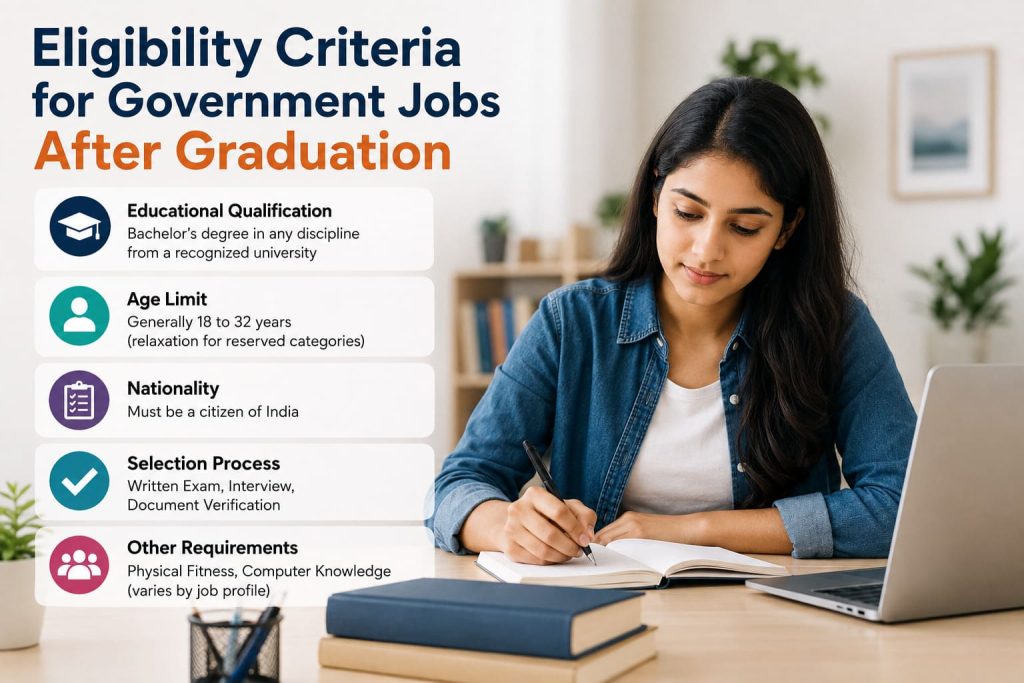
Eligibility for government jobs after graduation varies from one examination and position to another. While many graduate-level examinations accept candidates with a recognized bachelor’s degree, some posts require a specific subject, professional qualification, or additional certification.
1.Educational Qualification
A bachelor’s degree is a common requirement for many graduate-level government examinations. However, technical and specialist positions may require a specific degree.
For example, engineering recruitment may require an engineering qualification, while teaching positions may require relevant teaching qualifications.
2.Age Limit
Every recruitment notification specifies its own age criteria. Applicable age relaxations may be available to eligible candidates according to government rules.
3.Other Requirements
Depending on the post, candidates may also need to meet requirements related to:
- Physical standards
- Computer or typing skills
- Professional qualifications
- Work experience
- Medical standards
- Language requirements
Always check the latest official notification before applying because eligibility conditions can differ between recruitment cycles.
Popular Government Exams for Graduates
When exploring government jobs after graduation, understanding the major examinations can help you narrow down your options.Each exam has different eligibility criteria and career opportunities.
1.SSC CGL: A popular choice for graduates interested in different central government departments and offices.
2.UPSC Civil Services Examination: Suitable for candidates interested in administrative and civil service careers.
3.Banking Examinations: Candidates can explore eligible IBPS and SBI recruitment opportunities for careers in banking and financial services.
4.Railway Examinations: Railway recruitment can provide opportunities in different departments depending on the particular notification.
5.State PSC Examinations: Graduates interested in state-level government careers can explore examinations conducted by their respective State Public Service Commissions.
The syllabus, selection process, difficulty level, and preparation strategy differ from one examination to another. Therefore, it is better to select exams based on your career goals rather than preparing for every available vacancy.
About Career Planner – A Trusted Name in Competitive Exam Preparation
Career Planner has been helping students prepare for competitive examinations since 2008, with coaching and preparation support for SSC, Banking, Railway, Defence, CLAT, MBA, and other competitive exams. For graduates exploring government jobs after graduation, structured guidance can help them understand exam patterns and strengthen important subjects.
Career Planner focuses on organized learning, updated study material, regular practice, test series, doubt-clearing sessions, and expert guidance. This approach helps students stay consistent and build stronger exam preparation.This approach helps students stay consistent, improve their skills, and prepare confidently for their target exams.
How to Select the Right Government Job After Graduation
Choosing the right option among different government jobs after graduation requires more than simply looking at salary or popularity. Start by understanding your qualifications, interests, strengths, and career expectations.
Consider the following factors:
- Match the job with your qualification: Some positions are open to graduates from different streams, while others require specialized qualifications.
- Consider your interests: Decide whether you prefer administrative, banking, technical, teaching, financial, field-based, or other work.
- Understand the exam pattern: Check the syllabus, subjects, selection stages, and level of competition before choosing an examination.
- Consider the work profile: Learn about the responsibilities, working environment, transfers, and location requirements associated with the position.
- Think about long-term growth: Consider promotion opportunities, professional development, responsibilities, and career progression.
Choose a realistic preparation target: Focusing on one or two suitable examinations can be more effective than preparing for too many exams simultaneously.Graduates interested in State Government Jobs after graduation should also explore their state’s PSC and departmental recruitment opportunities.
How to Prepare for Government Exams After Graduation
Preparing for government jobs after graduation requires a clear strategy and regular practice. You do not need to study everything at once. Instead, divide your preparation into manageable stages.
1.Understand the Syllabus:Start with the latest official syllabus. Identify the subjects, important topics, question types, and selection stages.
2.Create a Study Schedule:Prepare a practical timetable based on your available time. Give appropriate time to each subject and include regular revision.
3.Build Strong Fundamentals:Strengthen your basics in subjects such as quantitative aptitude, reasoning, English, general awareness, or technical subjects according to your target examination.
4.Follow Current Affairs
Regularly study important national and international events, government schemes, awards, appointments, economy, sports, science and technology, and other exam-relevant developments.
5.Practice Previous-Year Questions
Previous-year papers can help you understand the question pattern, difficulty level, and frequently tested topics.
Career Benefits of Government Jobs After Graduation
Choosing government jobs after graduation can offer several career benefits depending on the position, organization, and applicable service rules.
- Structured Career Growth:Many government positions provide defined promotion structures and opportunities to take on greater responsibilities.
- Stable Career Environment:Government organizations generally operate under established service rules and procedures, which can provide a structured professional environment.
- Financial Benefits:Depending on the position, employees may receive salary, allowances, and other benefits according to the applicable pay structure and rules.
- Professional Development:Government employees may have opportunities to gain experience, take on new responsibilities, and progress within their departments.
- Public Service:Many government roles allow professionals to contribute to public administration and services that directly affect communities.
These benefits make government jobs after graduation an attractive option for many candidates, but applicants should also consider the responsibilities and requirements of each position.
Common Mistakes to Avoid During Government Jobs Preparation
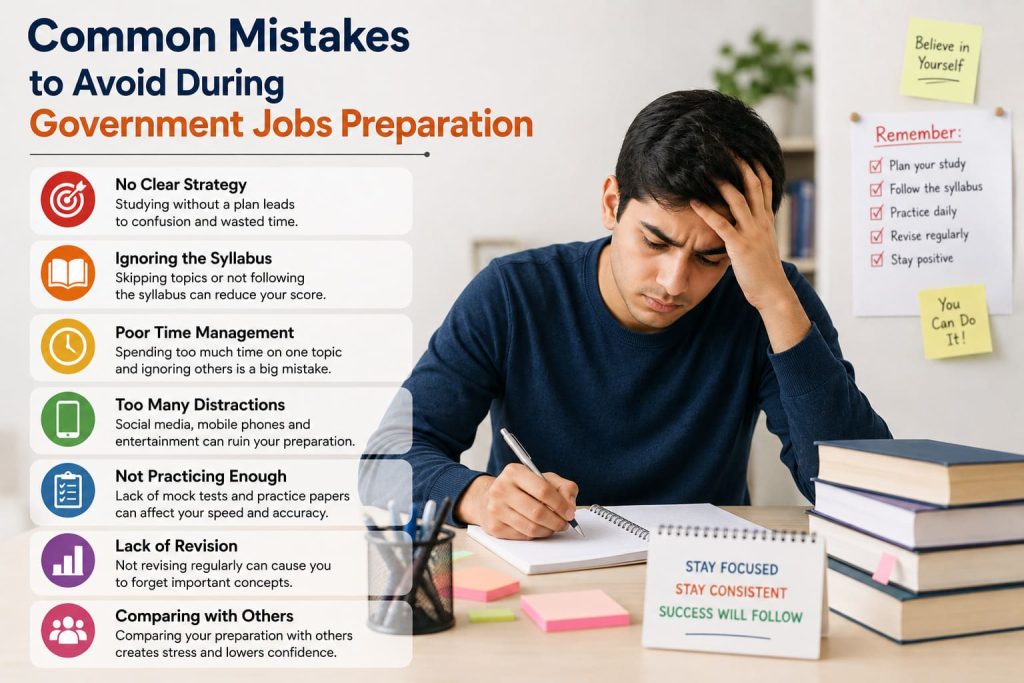
While preparing for government jobs after graduation, avoid common mistakes that can affect your progress.
- Preparing for too many exams: Applying for every vacancy can divide your attention. Choose examinations with suitable eligibility and overlapping preparation areas.
- Ignoring the official syllabus: Always understand the latest syllabus and exam pattern before creating your study plan.
- Using too many resources: Constantly changing books, notes, and online resources can create confusion. Choose reliable study material and use it consistently.
- Skipping revision: Reading a topic once does not guarantee retention. Schedule regular revision.
- Avoiding mock tests: Practice is essential for improving speed, accuracy, and time management.
- Ignoring previous-year papers: Previous-year questions can help you understand what the examination actually tests.
- Studying without a target: Set weekly and monthly preparation goals so you can track your progress.
A focused and consistent approach can make preparation more manageable and help you stay motivated.
Why Choose Career Planner for Government Exam Preparation?
Choosing the right coaching institute can provide structure and guidance while preparing for government jobs after graduation. Career Planner offers exam-focused preparation and student support for several competitive examinations.
Key reasons to consider Career Planner include:
- Established experience: Career Planner has been supporting competitive-exam aspirants since 2008.
- Experienced mentorship: Students receive guidance to help them understand exam requirements and preparation strategies.
- Updated study material: Learning resources are designed to support preparation according to current examination requirements.
- Regular test series: Mock tests provide opportunities to practice and evaluate performance.
- Doubt-clearing sessions: Students can clarify questions and strengthen areas where they need additional support.
- Workshop classes: Focused sessions can help students revise important concepts and improve exam readiness.
- Multiple exam options: Career Planner supports preparation for SSC, Banking, Railway, Defence, CLAT, MBA, and other competitive examinations.
Start Your Government Exam Preparation with Career Planner
Finding suitable government jobs after graduation is the first step toward your career goal. Whether you are preparing for SSC, Banking, Railway, or another competitive examination, Career Planner provides structured learning, study resources, practice tests, and expert guidance to support your preparation.
Choose your target exam, understand its requirements, follow a realistic study plan, and start preparing with confidence.
Contact Information
Career Planner
Address: CP House, Atal Path, off Boring Road, Shivpuri, Patna, Bihar 800023
Phone: 9386347918
Email: careerplannerindia@gmail.com
Conclusion
Government jobs after graduation offer diverse career opportunities across central and state government departments, banking, railways, teaching, defence, technology, and engineering. Graduates from Arts, Commerce, Science, Engineering, Computer Science, and other streams can explore suitable career paths based on their qualifications and interests.
Before choosing a career, check the eligibility criteria, job profile, exam pattern, and career prospects. If you are preparing for government jobs after graduation, choose the right exam, follow the syllabus, practice regularly, and revise consistently to move closer to your career goal.
FAQs – Government Jobs After Graduation: Complete Career Guide
Q1. How can I get a government job easily after graduation?
Ans. There is no government job that can be guaranteed or obtained easily. Choose an examination that matches your qualification, understand the syllabus, practice previous-year questions, take mock tests, and maintain consistent preparation.
Q2. Which government job is not stressful?
Ans. Stress levels vary according to the post, department, responsibilities, workload, location, and work environment. Instead of looking for a completely stress-free government job, compare the duties and working conditions of different positions.
Q3. Which government jobs are available after graduation?
Ans. Graduates can explore SSC, banking, railway, civil services, defence, teaching, state government, technical, administrative, finance, and other department-specific opportunities. Eligibility varies by post and recruitment notification.
Q4. Which competitive exams can graduates take for government jobs?
Ans. Graduates can consider SSC CGL, UPSC Civil Services, banking recruitment examinations, railway examinations, State PSC examinations, defence-related examinations, and other graduate-level recruitment tests, depending on their eligibility.
Q5. How should I prepare for government exams after graduation?
Ans. Start by selecting a suitable examination, understanding its syllabus, creating a study schedule, strengthening basic concepts, practicing previous-year papers, following relevant current affairs, taking mock tests, and revising regularly.


