

Government Exams After Graduation provide graduates with opportunities to pursue careers in central and state government departments, banking, railways, defence, education, public-sector organisations, and other government institutions. Depending on your degree, age, eligibility, and career interests, you can explore exams such as SSC CGL, banking examinations, railway recruitment exams and various state government examinations.
Choosing the right examination is an important first step. Candidates should understand the eligibility criteria, age limit, syllabus, exam pattern, selection process, and preparation requirements before applying. This guide explains popular Government Exams After Graduation, eligibility requirements, how to choose a suitable exam, and practical preparation strategies.
Government Exams After Graduation: What Are Your Options?
Different government organisations conduct recruitment examinations for various posts, and eligibility requirements can vary depending on the position.
Some common options include:
- SSC examinations: SSC CGL is a popular option for graduates seeking positions in different central government departments and offices.
- Banking examinations: Graduates can explore examinations conducted for positions such as Probationary Officer and other banking roles.
- Railway examinations: Railway recruitment provides opportunities for eligible graduates through different recruitment examinations.
- State government examinations: State Public Service Commissions and other state recruitment bodies conduct examinations for different government positions.
The right option depends on your educational qualification, interests, age, location preferences, and career goals.
Popular Government Exams After Graduation
Candidates can explore different government exams based on their qualifications and career interests. Some major categories include:
- SSC CGL
The Staff Selection Commission conducts the Combined Graduate Level examination for recruitment to various Group B and Group C posts in central government departments and organisations. Candidates should check the latest notification for post-wise eligibility requirements.
- Banking Exams
Graduates can explore banking recruitment examinations conducted by organisations such as IBPS and SBI. Depending on the examination, candidates may apply for positions such as Probationary Officer or other banking roles.
- Railway Government Jobs
The Railway Recruitment Boards conduct recruitment for various posts. Graduate-level opportunities can include posts under different RRB recruitment cycles. Candidates should always check the latest notification for educational qualifications, age requirements, syllabus, and selection process.
- State Government Examinations
State-level recruitment bodies conduct examinations for administrative, teaching, technical, clerical, and other positions. These can be useful options for candidates who prefer government employment within a particular state.
Eligibility Criteria for Government Exams After Graduation
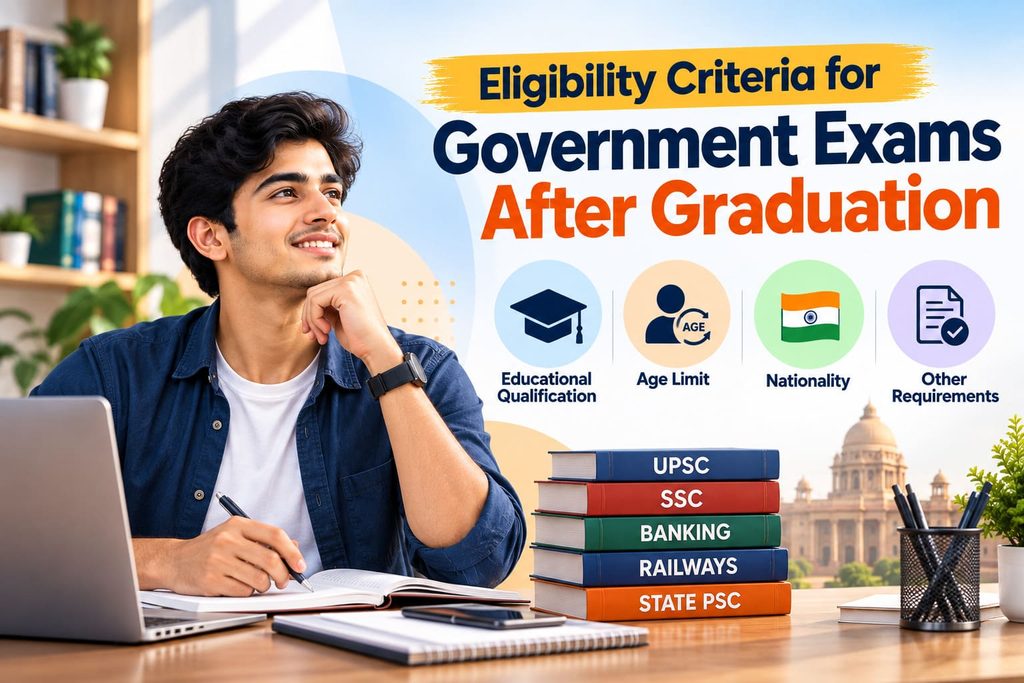
Eligibility criteria vary from one examination to another. Candidates should never assume that graduation alone makes them eligible for every government position.
Important factors usually include:
- Educational qualification
- Age limit
- Nationality requirements
- Required subject or degree
- Post-specific qualifications
- Experience requirements, where applicable
- Category-based age relaxation, where applicable
For example, some examinations require a bachelor’s degree in any discipline, while technical positions may require a specific engineering or professional qualification.
Government Exams After Graduation: Age Limit and Qualification
Age eligibility is another important factor when selecting Government Exams After Graduation. The minimum and maximum age limits can differ significantly between examinations and posts.
Graduates should therefore check:
- Minimum and maximum age requirements.
- Cut-off date for calculating age.
- Required educational qualification.
- Post-specific qualifications.
- Category-based relaxation rules.
- Other eligibility conditions.
Some recruitment examinations also provide age relaxation for eligible candidates according to applicable government rules. However, the exact requirements depend on the examination, post, category, and recruitment notification.
How to Select the Right Government Exam
With so many Government Exams After Graduation, choosing the right one can feel confusing. Instead of applying for every available examination, compare your options carefully.
Consider the following factors:
1. Your Educational Background
Your degree can influence the examinations and posts available to you. For example, candidates with engineering backgrounds can explore relevant government engineering jobs, while computer science graduates may find opportunities through computer science government jobs and technical recruitment.
2. Your Career Interests
Think about the type of work environment and responsibilities you prefer. Some candidates may be interested in administrative positions, while others may prefer banking, railways, defence, teaching, or technical roles.
3. Eligibility Requirements
Always compare your qualification and age with the official eligibility criteria before applying.
4. Exam Pattern
Different examinations test different subjects and skills. Understanding the exam pattern can help you determine whether the examination matches your strengths and preparation time.
5. Preparation Time
Consider how much time you can realistically dedicate to government job preparation. Selecting one or two suitable examinations can make preparation more focused.
Government Exam Syllabus and Exam Pattern
Understanding the syllabus and exam pattern should be one of the first steps in your preparation. The syllabus tells you what topics you need to study, while the exam pattern explains how the examination is structured.
Depending on the examination, subjects may include:
- Quantitative Aptitude
- Reasoning
- English Language
- General Awareness
- Current Affairs
- Computer Knowledge
- Subject-specific topics
Candidates should download or carefully review the latest syllabus and notification from the relevant official recruitment body. Avoid preparing from outdated information because examination patterns and recruitment requirements can change.
How to Start Preparing for Government Exams After Graduation
A structured preparation plan can make Government Exams After Graduation easier to manage. Beginners should avoid trying to cover everything at once.
Step 1: Select Your Target Examination
Start by choosing an examination that matches your qualification, interests, and career goals.
Step 2: Understand the Syllabus
Divide the syllabus into individual subjects and topics. Identify areas that you already understand and topics that require more attention.
Step 3: Create a Study Schedule
Prepare a realistic daily and weekly timetable. Include time for:
- Concept learning
- Question practice
- Current affairs
- Revision
- Previous-year papers
- Mock tests
Step 4: Build Strong Fundamentals
Before focusing heavily on speed, develop a clear understanding of important concepts. Strong fundamentals can make advanced questions easier to handle.
Step 5: Analyse Your Performance
After solving practice sets and mock tests, identify your mistakes. Focus on why you made the mistake and what you can do to avoid repeating it.
About Career Planner
Career Planner has been helping students prepare for competitive examinations since 2008, with preparation support for SSC, Banking, Railway, Defence, CLAT, MBA, and other competitive examinations. For students preparing for Government Exams After Graduation, structured guidance can help them understand examination requirements, strengthen important subjects and develop better exam-taking skills.
Career Planner focuses on organised learning, updated study resources, regular practice, test series, doubt-clearing sessions, and expert guidance. This structured approach helps aspirants maintain consistency, track their preparation progress, and stay focused throughout their government job preparation.
Subject-Wise Preparation Strategy
A subject-wise strategy can help candidates organise their preparation and spend more time on areas that need improvement.
- Quantitative Aptitude
Start with basic concepts and gradually move toward exam-level questions. Practise topics such as percentages, averages, ratios, profit and loss, time and work, data interpretation, and other topics included in your target examination.
Focus on accuracy first and gradually improve your solving speed.
- Reasoning
Practise different types of reasoning questions regularly. Topics may include series, coding-decoding, syllogism, inequalities, puzzles, seating arrangements, and logical reasoning.
Timed practice can help improve question selection and speed.
- English
Build your vocabulary and strengthen grammar fundamentals. Regularly practise reading comprehension, error detection, sentence improvement, cloze tests, and other relevant question types.
Reading newspapers or reliable English content can also help improve reading ability.
- General Awareness and Current Affairs
Keep up with important national and international developments, government schemes, economic updates, awards, sports, science, and other topics relevant to your examination.
Instead of collecting too many sources, choose reliable study material and revise regularly.
- Computer Knowledge
For examinations that include computer-related questions, revise basic computer concepts, operating systems, internet fundamentals, networking, cybersecurity basics.
and other topics mentioned in the syllabus.
Importance of Previous-Year Question Papers
Previous-year question papers are an important resource for Government Exams After Graduation. They help candidates understand the types of questions asked, difficulty level, recurring topics, and time pressure.
When solving previous-year papers:
- Attempt them under timed conditions.
- Avoid checking answers while solving.
- Record questions you could not solve.
- Analyse incorrect answers.
- Identify frequently tested topics.
- Revise weak areas.
- Repeat important question types.
Previous-year papers should not replace concept learning, but they can make your preparation more exam-oriented. Regular practice with these papers can also help you identify important topics, understand question patterns, and improve your time management before the actual examination.
Role of Mock Tests and Test Series
Mock tests provide an opportunity to practise under conditions similar to the actual examination. Regular tests can help candidates improve time management, question selection, speed, and accuracy.
A useful mock-test routine includes:
- Take a full or sectional mock test.
- Review your score.
- Identify incorrect and unanswered questions.
- Analyse the reason behind each mistake.
- Revise the related topic.
- Attempt similar questions again.
A government job preparation strategy becomes more effective when candidates use mock tests not just to measure scores but also to understand their strengths and weaknesses.
Common Mistakes to Avoid During Preparation
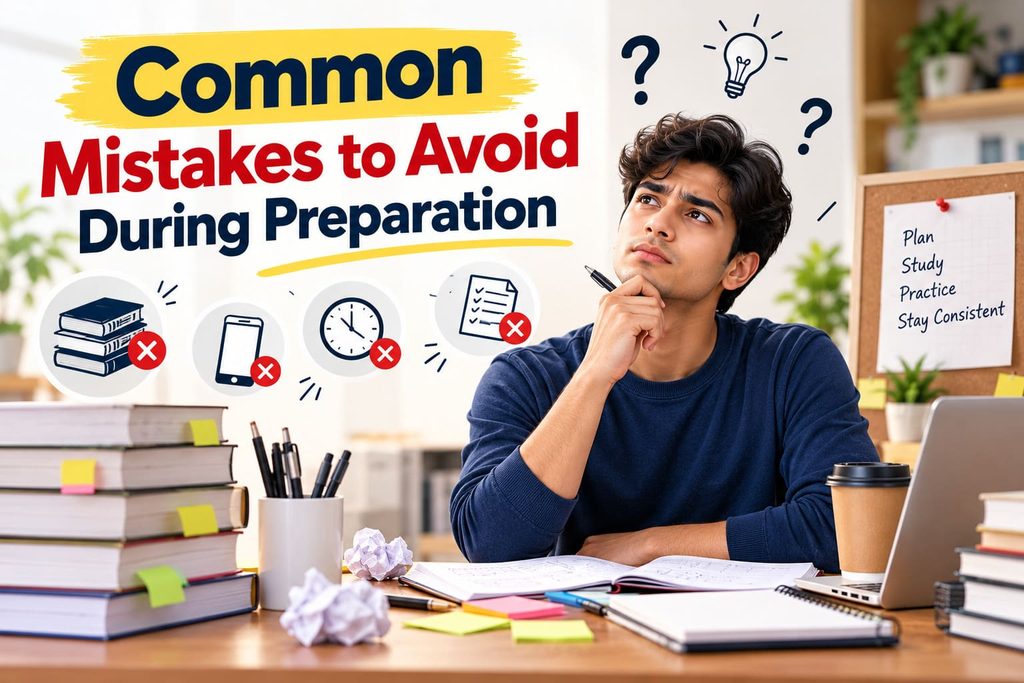
Many candidates face difficulties not because of a lack of ability, but because their preparation is not consistent or organised.
- Studying Without Understanding the Syllabus
Do not begin preparation without knowing what your examination covers. Start with the latest official syllabus and exam pattern.
- Ignoring Previous-Year Papers
Previous-year questions provide valuable information about the actual examination. Include them in your preparation routine.
- Taking Mock Tests Without Analysis
Simply completing mock tests is not enough. Spend time analysing mistakes and improving weak areas.
- Ignoring Revision
Learning a topic once does not guarantee that you will remember it during the examination. Schedule regular revision.
Why Choose Career Planner for Government Exam Preparation?
Choosing the right guidance can make Government Exams After Graduation preparation more organised and focused.
Career Planner supports aspirants with structured learning, updated study resources, regular practice, mock tests, test series, doubt-clearing support, and expert guidance.
Key benefits include:
- Experienced Faculty: Guidance from experienced teachers can help students understand difficult concepts and improve their problem-solving approach.
- Updated Study Material: Relevant resources help students prepare according to the applicable syllabus and examination requirements.
- Regular Mock Tests: Exam-like practice helps candidates work on speed, accuracy, and time management.
- Test Series: Regular tests help aspirants assess their preparation and identify areas that need improvement.
- Doubt-Clearing Support: Students can clarify difficult topics and correct conceptual mistakes.
- Structured Learning: A planned learning approach helps candidates maintain consistency throughout their preparation.
With the right approach and consistent effort, aspirants can make their Government Exams After Graduation preparation more structured and effective. Career Planner helps students stay focused, strengthen their concepts, practise regularly, analyse their performance, and build the confidence needed to approach their target examination with better preparation.
Start Your Government Exam Preparation with Career Planner
Choosing the right Government Exams After Graduation is important, but consistent preparation matters too. Career Planner provides structured learning, updated study resources, regular practice, mock tests, and expert guidance to help aspirants stay focused and prepare effectively.
With organised preparation and consistent effort, graduates can work toward their target government examination and explore suitable government jobs for graduates.
Contact Information
Career Planner
Address: CP House, Atal Path, off Boring Road, Shivpuri, Patna, Bihar 800023
Phone: 9386347918
Email: careerplannerindia@gmail.com
Conclusion
Choosing the right Government Exams After Graduation is important, but consistent preparation is equally necessary. Career Planner provides structured learning, updated study resources, regular practice, mock tests, and expert guidance to support aspirants.
Start by understanding the latest eligibility criteria and syllabus, then create a realistic study plan. Regular practice, revision, previous-year papers, and mock tests can help you stay focused and improve exam readiness.
FAQs – Government Exams After Graduation: Exams, Eligibility & Preparation
Q1. Which government exam is best after graduation?
Ans. There is no single examination that is suitable for every graduate. Candidates can consider SSC, banking, railway, UPSC, defence, and state government examinations based on their educational qualification, interests, eligibility, and career goals.
Q2. What are the most popular Government Exams After Graduation in India?
Ans. Popular options include SSC CGL, banking examinations, railway recruitment examinations, UPSC examinations, defence examinations, and various state government examinations. Eligibility and selection processes vary for each examination.
Q3. What is the eligibility criteria for Government Exams After Graduation?
Ans. Eligibility varies by examination and post. Candidates may need to meet specific educational qualification, age, nationality, subject, and other requirements. Always check the latest official notification before applying.
Q4. How should I start preparing for Government Exams After Graduation?
Ans. Start by selecting a suitable examination and understanding its latest syllabus and exam pattern. Create a realistic study schedule, build strong fundamentals, practise questions regularly, solve previous-year papers, revise important topics, and take mock tests.
Q5. Which study materials and mock tests are useful for Government Exams?
Ans. Use reliable study material that follows the latest syllabus and examination requirements. Previous-year question papers, subject-wise practice sets, mock tests, and test series can help improve conceptual understanding, speed, accuracy, time management, and exam readiness.


